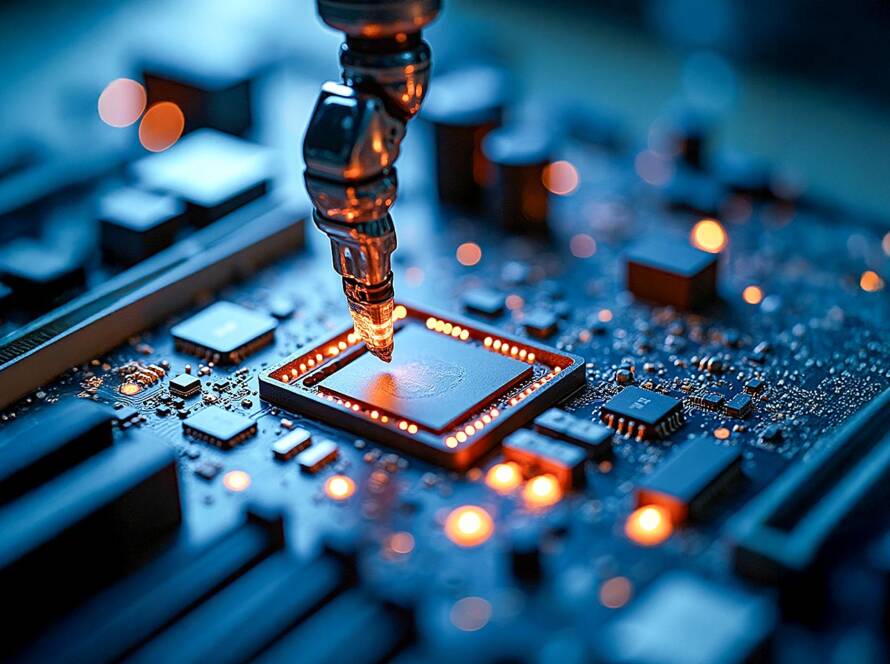
If recent years marked the rise of Generative AI experimentation, the coming years will see AI get truly physical. The convergence of Artificial Intelligence, the Internet of Things (IoT), and Robotics — collectively known as AIoT — is moving beyond theoretical pilots to become the backbone of modern industry.
The trend is clear: we are transitioning from “smart” devices that simply collect data to autonomous systems that physically act upon it.
The Core Shift: From Vision-Language to “Action”
The most significant technological leap ahead is the emergence of Vision-Language-Action (VLA) models. Unlike traditional robots that require explicit, line-by-line coding for every movement, VLA-powered systems use Generative AI to “see” an environment and “understand” a command to generate fluid physical actions.
For example, instead of programming coordinates for a robot arm to pick up a specific part, an operator can simply say, “Sort the defective circuit boards into the red bin.” The robot’s VLA model processes the visual feed, identifies the defects based on learned patterns, and executes the motor controls autonomously. This lowers the barrier to entry for automation, allowing non-technical staff to deploy complex robotic tasks.
Key Trends Defining AIoT Robotics in the Coming Years
| Trend | Outlook & Impact |
|---|---|
| Neuro-Symbolic AI | Why it matters: Pure Deep Learning can be unpredictable. Neuro-Symbolic AI combines neural networks’ learning with rule-based logic. Impact: Robots learn new tasks but are mathematically constrained to never violate safety protocols, enabling safe human collaboration. |
| Edge AI & Neuromorphic Chips | Why it matters: Cloud latency is too slow for real-time robotics. New chips achieve exceptional efficiency. Impact: Robots process sensory data locally, reducing bandwidth costs and ensuring operation even if networks fail. |
| Agentic AI Workflows | Why it matters: Moving from passive bots to active agents. Impact: An AIoT maintenance bot autonomously diagnoses faults, checks inventory, orders parts, and schedules downtime. |
| Humanoid Commercialisation | Why it matters: General-purpose robots entering real-world production. Impact: Early deployment in “brownfield” factories with stairs and narrow aisles where wheeled robots struggle. |
The “Neuromorphic” Edge: Processing Data Like a Brain

A critical enabler is the maturity of neuromorphic computing. Traditional chips process data sequentially; neuromorphic chips mimic the human brain, activating only on events.
For AIoT robotics, this extends battery life dramatically, unlocking use cases in remote asset monitoring, agriculture, and hazardous environments where constant cloud connectivity is impractical.
6G and “Swarm” Intelligence
While 5G provides connectivity, emerging 6G research focuses on “Integrated Sensing and Communication” (ISAC), turning networks into sensors themselves.
This enables Swarm Robotics, where hundreds of robots coordinate as one entity for heavy loads or complex assembly, with near-zero latency communication.
Conclusion
The “AI + IoT + Robotics” evolution is about closing the loop between digital intelligence and physical action. With VLA models, Neuro-Symbolic AI, and edge advancements, robots will become safer, smarter, and more autonomous.
For Global Research, the opportunity lies in the infrastructure: specialised edge AI chips, secure private networks, and integration platforms that unify these systems. IoT connectivity remains the essential backbone for this physical AI revolution.